


TL;DR:
- Eco friendly pet food is defined by sustainable sourcing, ethical ingredient choices, and eco-conscious packaging practices. Ingredient selection accounts for most environmental impact, with plant-based diets requiring significantly less land and emissions than red meat options. Genuine sustainability relies on measurable standards, transparency, and nutritional integrity, not marketing claims or unregulated labels.
Millions of pet owners scan ingredient labels looking for words like “natural” or “organic,” assuming those words signal environmental responsibility. They don’t. What is eco friendly pet food, really? It’s a specific category defined by measurable sustainability factors: how proteins are sourced, how packaging is handled, and whether the product meets nutritional standards without excessive environmental cost. The gap between marketing language and genuine sustainability is wider than most people realize, and understanding that gap is the first step toward feeding your pet in a way that’s good for them and for the planet.
Table of Contents
- Key takeaways
- What eco friendly pet food actually means
- Packaging: what works, what doesn’t, and what’s changing
- Nutrition: eco friendly food must still feed the animal
- How to choose eco friendly pet food without getting misled
- My take on eco friendly pet food
- Eco friendly pet care at Mindfulbotany
- FAQ
Key takeaways
| Point | Details |
|---|---|
| Ingredients drive most impact | Ingredient selection accounts for roughly 70% of a pet food’s total environmental footprint. |
| Plant-based beats beef significantly | Plant-based dog food uses 37 times less land and emits far fewer greenhouse gases than beef-based diets. |
| “Natural” is not regulated | Labels like “natural” carry no legal sustainability requirement; certifications and ingredient transparency matter more. |
| Packaging matters less than you think | Switching to recyclable packaging helps, but ingredient choice delivers far greater environmental benefit. |
| Nutrition must come first | Eco-friendly pet food should meet AAFCO standards and be formulated by veterinary nutritionists to keep pets healthy. |
What eco friendly pet food actually means
The phrase “eco friendly pet food” covers a specific set of practices, not just a feel-good marketing claim. At its core, a food qualifies as eco friendly when its full life cycle, from ingredient farming through manufacturing and packaging, minimizes harm to land, water, and climate systems.
Ingredient sourcing is where the real leverage lies. Ingredient selection accounts for approximately 70% of a pet food’s total environmental impact. That single number reframes where consumers should focus their attention. Choosing the right protein source matters more than the recyclability of the bag it comes in.
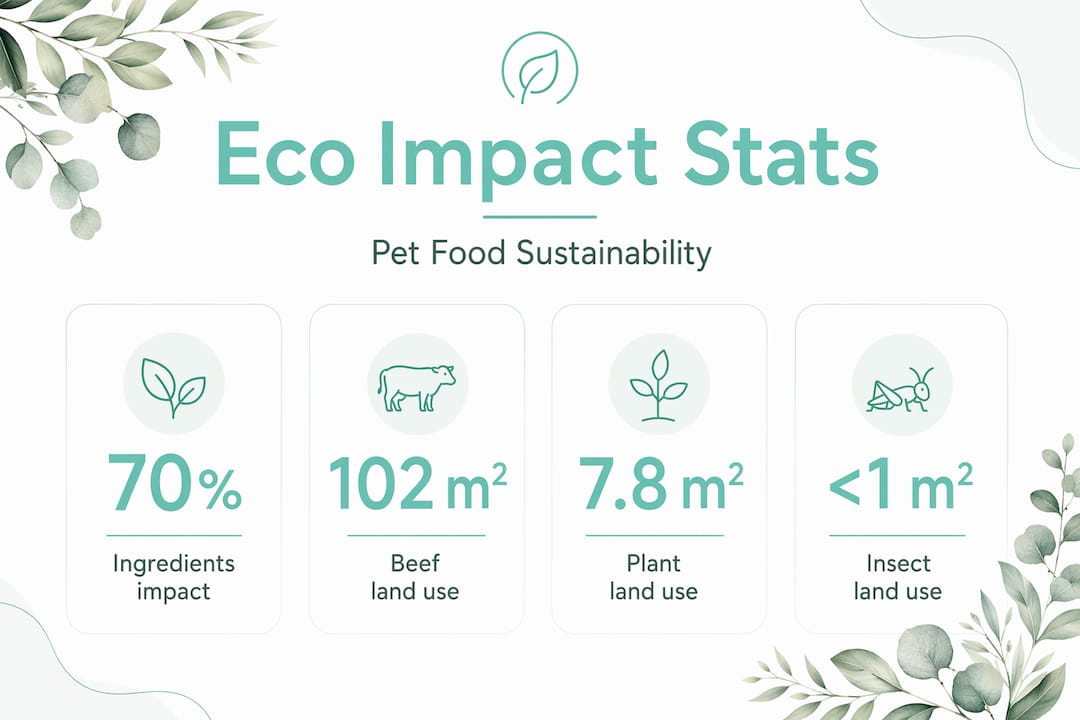
The comparison across protein sources is stark. Beef-based diets require 102.15 m² of land per 1,000 kcal, while plant-based formulations need just 2.73 m². On emissions, beef-based diets generate 31.47 kg of CO₂ equivalent per 1,000 kcal versus 2.82 kg for plant-based options. Poultry sits in the middle, requiring less land and water than red meat but more than plant proteins.
| Protein source | Land use (m² per 1,000 kcal) | CO₂eq (kg per 1,000 kcal) |
|---|---|---|
| Beef | 102.15 | 31.47 |
| Poultry | ~15–20 (estimated) | ~5–8 (estimated) |
| Plant-based | 2.73 | 2.82 |
| Insect protein | Very low | Very low |
Alternative proteins like insect meal are gaining traction in sustainable pet food options. Insects require a fraction of the land and water of conventional livestock and can be farmed on organic waste streams. Ethical sourcing certifications like Global Animal Partnership and Certified Humane add another layer of accountability, signaling that animal welfare standards were maintained throughout production.
Pro Tip: When evaluating a brand, skip straight to the first three ingredients on the label. The protein source listed first determines the bulk of the environmental footprint. Chicken or plant-based proteins listed first are a cleaner starting point than beef or lamb.
Packaging: what works, what doesn’t, and what’s changing
Packaging is visible, tangible, and easy to feel good about recycling. But the reality of pet food packaging is more complicated than the chasing arrows symbol suggests.

About 300 million pounds of pet food packaging waste are generated in the US each year, and over 99% of it ends up in landfills. The main culprit is multi-layer laminate film, which bonds plastic, aluminum, and adhesive layers together for durability and freshness. That combination is exactly what makes it unrecyclable in standard municipal programs.
Here’s what most recycling symbols on pet food bags actually mean in practice:
- Multi-layer laminate bags: Not accepted in curbside recycling. Require specialized drop-off programs or mail-in services like TerraCycle.
- Polypropylene trays and containers: Technically recyclable in some regions, but acceptance varies significantly by local infrastructure. Never assume curbside pickup.
- Metal cans: Generally accepted in most municipal recycling programs. One of the more reliably recyclable formats.
- Paper-based packaging: Emerging in the market. Some brands using paper-based formats report CO₂ emission reductions of up to 75% compared to fossil-based plastics.
- Compostable and bio-based plastics: Industrial compostable options exist but require specific composting facilities. Home compostability is rare and inconsistently certified.
The most promising shift in the industry is toward recyclable mono-material films, which are single-polymer structures that standard recycling equipment can actually process. Some brands are also piloting refill programs to reduce packaging volume entirely.
Pro Tip: Before assuming a pet food bag is recyclable, check the brand’s website for a specific recycling program partnership. Many flexible pet food bags require store drop-off at retailers that participate in polyethylene film collection, not your curbside bin.
Nutrition: eco friendly food must still feed the animal
Sustainability without nutritional completeness is not a solution. It’s a tradeoff that fails the pet. This is where eco friendly pet food gets more nuanced, because not every protein reduction or plant-based swap is appropriate for every species.
Dogs are biologically omnivores. Eleven out of twelve studies reviewed in recent research support that dogs can thrive on vegan or vegetarian diets when those diets are nutritionally complete. That means formulated to meet AAFCO standards, ideally by a board-certified veterinary nutritionist, and tested to confirm that essential amino acids like taurine, L-carnitine, and methionine are present at adequate levels.
Cats are a different case. They are obligate carnivores with specific metabolic requirements for nutrients like taurine, arachidonic acid, and preformed vitamin A, all of which are found naturally in animal tissue. Fully plant-based diets for cats require precise supplementation and should only be pursued under veterinary guidance.
Common misconceptions worth addressing directly:
- “Plant-based means nutritionally incomplete.” Not true for dogs when the formula meets AAFCO standards. Incomplete nutrition comes from poor formulation, not plant proteins themselves.
- “Organic automatically means eco friendly.” Organic certification addresses pesticide use and farming practices but says nothing about carbon footprint, land use, or packaging.
- “Grain-free is better for the environment.” Grain-free diets often substitute legumes for grains, which can be equally or more resource-intensive depending on sourcing. The environmental claim isn’t automatic.
Whole food ingredients that appear frequently in well-formulated environmentally safe pet food include sweet potato, lentils, chickpeas, flaxseed, and kelp. These ingredients deliver fiber, omega fatty acids, and micronutrients while keeping the environmental footprint low. For a deeper look at natural pet food benefits and how whole food ingredients support health outcomes, that resource is worth reviewing.
How to choose eco friendly pet food without getting misled
Reading a label critically is a skill. Most pet food marketing is designed to create positive impressions, not deliver precise environmental data. Here’s how to sort signal from noise.
- Check the protein source first. The first ingredient tells you the most about the environmental footprint. Plant-based or poultry-based proteins carry a lower impact than beef or lamb. Look for specificity: “chicken meal” is more traceable than “meat meal.”
- Look for recognized certifications. Labels worth trusting include Certified Humane, Global Animal Partnership (for animal welfare in sourcing), and USDA Organic (for farming practices). A brand claiming sustainability without any third-party certification is relying on your trust without earning it.
- Identify greenwashing signals. Watch for phrases like “eco-conscious,” “green,” or “planet-friendly” without supporting data. Transparent sourcing details and verifiable supply chain information are what separate credible brands from marketing claims.
- Evaluate packaging realistically. Prioritize brands using metal cans, mono-material films, or those with active recycling partnerships over brands using multi-layer laminates with no recycling solution.
- Transition your pet gradually. Switch from current food to a new formula over seven to ten days, mixing increasing proportions of the new food with the old. This reduces the risk of digestive upset, particularly for pets with sensitive stomachs.
- Consider wet versus dry carefully. Wet pet food carries roughly eight times the environmental impact of dry food due to water content, packaging volume, and manufacturing energy. Dry food with low-impact proteins is typically the greener choice by volume.
For practical guidance on choosing healthy dog food with quality and sustainability in mind, that resource covers selection criteria in detail.
Pro Tip: Ask brands directly where their ingredients are sourced and whether their formulas were developed with a veterinary nutritionist. Brands committed to genuine sustainability are usually willing to answer. Ones that deflect or respond with vague marketing language are telling you something.
My take on eco friendly pet food
I’ve spent time reviewing a lot of sustainability claims in the pet food space, and the honest truth is that this category is still maturing. The science on plant-based diets for dogs is genuinely compelling. Shifting companion animals to lower-impact diets could free up agricultural land at a scale that exceeds the territory of entire countries. That’s not a small number.
But I’ve also seen how quickly “eco friendly” becomes a branding exercise rather than a meaningful commitment. Switching the bag to paper while keeping beef as the primary protein is a cosmetic change. What I’ve found actually moves the needle is ingredient selection. That’s where the 70% impact lives, and that’s where informed purchasing decisions make a real difference.
My recommendation for anyone starting this process: don’t try to overhaul everything at once. Start by understanding what your pet’s current food contains, find a lower-impact protein alternative that meets AAFCO standards, and verify the packaging situation separately. True sustainability in pet food, as the research consistently confirms, integrates responsible sourcing with ethical animal welfare, nutritional completeness, and supply chain transparency. No single product checks all boxes perfectly. But every informed choice moves in the right direction.
— Ashley
Eco friendly pet care at Mindfulbotany
Mindfulbotany is a health and wellness marketplace for people and pets, and that includes products that align with eco-conscious feeding values. For pet owners building a more sustainable care routine, the soft chew dog supplements at Mindfulbotany are formulated with plant-based ingredients designed to support pet wellness without unnecessary fillers. For grooming, the TropiClean OxyMed Oatmeal Treatment Pet Shampoo uses natural, gentle ingredients that complement a low-impact pet care routine. Sustainable feeding and sustainable grooming work together. Mindfulbotany carries both sides of that equation.
FAQ
What makes pet food eco friendly?
Eco friendly pet food uses low-impact protein sources, ethical ingredient sourcing, and packaging designed to reduce landfill waste. Ingredient selection accounts for roughly 70% of the environmental footprint, making protein choice the single most important factor.
Can dogs thrive on plant-based pet food?
Yes. Dogs are omnivores, and research shows nutritionally complete plant-based diets support healthy outcomes in the majority of studies reviewed. The formula must meet AAFCO standards and include all essential amino acids.
Is “natural” pet food the same as eco friendly?
No. “Natural” is an unregulated label in the pet food industry and carries no environmental requirement. Eco friendly pet food is defined by verifiable sustainability practices, not marketing language.
How do I recycle pet food packaging?
Most flexible pet food bags are not accepted in curbside recycling programs. Check whether the brand participates in a drop-off or mail-in program, and verify local recyclability before placing packaging in a standard bin.
How do I switch my pet to an eco friendly diet safely?
Transition over seven to ten days by gradually increasing the proportion of the new food while decreasing the old. This minimizes digestive disruption and gives your pet time to adjust to new ingredients and protein sources.
0 comments