


TL;DR:
- Pet owners often believe that “natural” pet foods are automatically healthier, but regulation does not guarantee nutritional adequacy or safety. Scientific evidence indicates that factors like formulation, ingredient digestibility, and quality control are more crucial for pet health than claims of natural sourcing. To ensure optimal wellness, owners should verify nutritional standards, consult veterinarians, and prioritize balanced, tested diets over marketing labels alone.
Pet food labels make big promises, and “natural” is one of the most common claims you’ll find. Many pet owners assume that natural automatically means healthier, safer, or more nutritious than conventional options. Recent research challenges that assumption in ways that may surprise you. This guide cuts through the marketing noise, explains what “natural” actually means under regulatory standards, reviews the real science on natural ingredients and pet health, and gives you a practical framework for making diet decisions that genuinely support your pet’s long-term wellness.
Table of Contents
- What does “natural diet” actually mean for pets?
- What does science say about natural ingredients and pet health?
- The raw diet debate: Perceived perks and real risks
- A practical approach: How to choose a safe, natural diet for your pet
- Why “natural” is only part of the real solution for pet health
- Support your pet’s health journey with trusted natural options
- Frequently asked questions
Key Takeaways
| Point | Details |
|---|---|
| Natural label is not enough | Nutritional adequacy and safety matter more than whether a diet is labeled ‘natural’. |
| Check for balanced nutrition | All pet foods should meet AAFCO or WSAVA nutrient standards regardless of ingredient source. |
| Raw diets have trade-offs | Raw feeding can offer some benefits but carries contamination and imbalance risks; always involve a vet. |
| Ingredient quality varies | Natural diets vary widely in processing and nutrient content—read labels and investigate brands carefully. |
| Work with your veterinarian | Professional guidance ensures your pet’s diet supports their long-term health and well-being. |
What does “natural diet” actually mean for pets?
The word “natural” appears on pet food packaging so frequently that it has lost much of its meaning for most shoppers. Before you can evaluate whether a natural diet is right for your pet, you need to understand what the term actually refers to in a regulatory context.
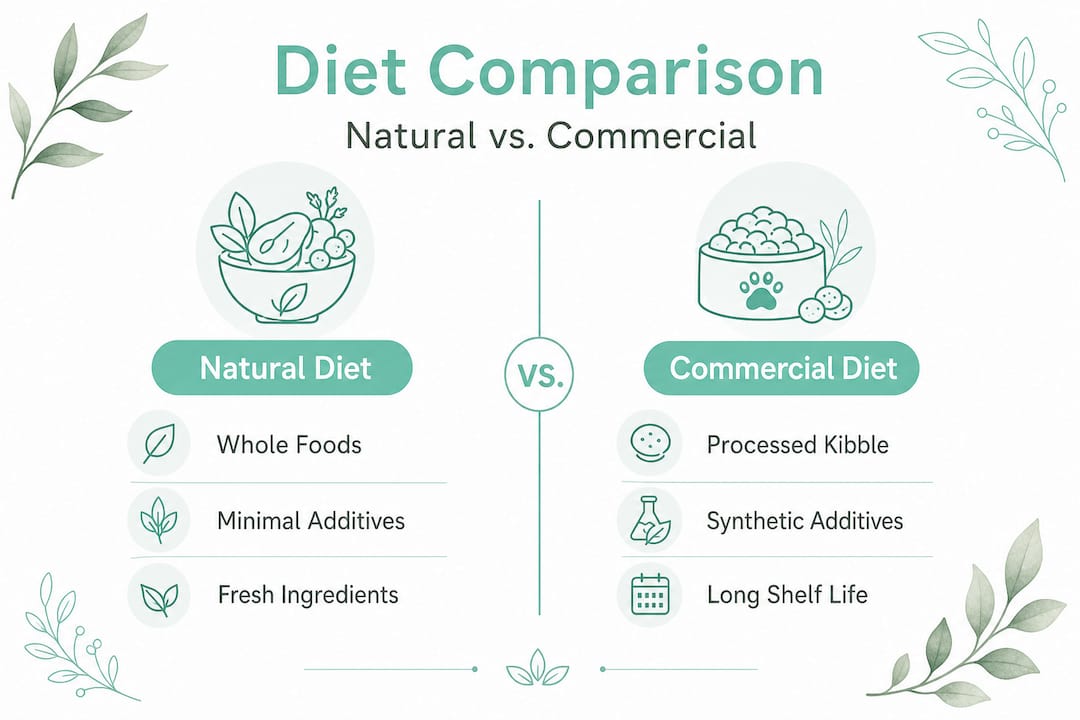
According to the AAFCO 2024 OP, Chapter 6, “natural” is defined as diets and ingredients sourced from plants, animals, or minerals that have not been chemically synthesized. Critically, this definition does not guarantee nutritional adequacy. A food can carry a “natural” label and still fall short of the nutrient profiles your pet actually needs.
Here is what the regulatory definition does and does not cover:
- Allowed processing methods: Drying, concentration, fermentation, rendering, extraction, hydrolysis, and similar physical or biological processes
- Excluded ingredients: Chemically synthesized vitamins, minerals, and preservatives (though these may be added separately with disclosure)
- Not regulated by the “natural” label: Nutritional completeness, ingredient quality, or sourcing standards
It is also worth separating “natural” from related terms that pet owners often use interchangeably:
| Term | What it means | What it does not guarantee |
|---|---|---|
| Natural | No chemically synthetic ingredients | Balanced nutrition or safety |
| Organic | Certified farming and processing standards | Nutritional completeness |
| Holistic | No regulatory definition; marketing only | Anything measurable |
| Raw | Uncooked ingredients | Pathogen-free or balanced macro/micronutrients |
“A ‘natural’ label tells you about ingredient sourcing and minimal chemical processing. It does not tell you whether the food will actually meet your pet’s needs.”
One of the most persistent misconceptions is that “natural” equals risk-free. Plenty of naturally occurring substances are toxic to pets, including certain plants, molds, and minerals at elevated doses. The pet wellness nutrition guide covers this distinction in more detail, and pet nutrition insights offer a broader view of how ingredient sourcing affects health outcomes. If you want to understand the tangible differences a natural formulation can make, reading about natural pet food benefits gives you a grounded starting point.
With confusion around what really counts as natural, the next step is understanding what’s actually in your pet’s food and whether any of it matters.
What does science say about natural ingredients and pet health?
Once you understand the regulatory baseline, the more important question becomes whether natural diets actually produce better health outcomes. The honest answer is: it depends heavily on formulation and nutritional completeness, not just ingredient origin.

A 2025 systematic review published on PubMed found that evidence does not support the idea that all synthetic additives and preservatives are harmful when used within regulatory limits. That is a meaningful finding because much of the consumer push toward natural diets is driven by fear of synthetic additives, not by evidence that those additives cause harm at the doses present in commercial pet foods.
What actually drives health outcomes in pet diets:
- Nutritional completeness: Meeting AAFCO or FEDIAF nutrient profiles for the pet’s life stage
- Ingredient digestibility: How well the pet can absorb and use the nutrients present
- Processing quality: Whether processing preserves or degrades key nutrients
- Quality control: Consistent formulation and testing across production batches
According to the WSAVA Nutrition Guidelines, practical benefit comes from nutritional adequacy and quality control, not from label claims alone. WSAVA recommends evaluating manufacturers based on whether they employ board-certified veterinary nutritionists, conduct feeding trials, and perform rigorous quality testing.
| Factor | Natural diets | Traditional/commercial diets |
|---|---|---|
| Ingredient sourcing | Plants, animals, minerals only | May include synthetics |
| Processing level | Minimal chemical processing | Variable; may include more additives |
| Nutritional completeness | Not guaranteed by label | Regulated if AAFCO statement present |
| Contamination risk | Variable; raw formats higher risk | Generally lower with established brands |
| Evidence of benefit | Ingredient-level, not label-level | Feeding trial data more common |
Pro Tip: Always look for an AAFCO nutritional adequacy statement on the label. It should say the food is “formulated to meet” or was tested to meet AAFCO nutrient profiles for your pet’s life stage. That statement matters far more than a “natural” claim.
Understanding essential nutrients for dogs helps clarify why the nutrient profile always outweighs the ingredient sourcing story on the label. If you want ingredient-level guidance, the best natural sources for dog nutrition outlines which whole food ingredients deliver the most reliable nutritional value.
The raw diet debate: Perceived perks and real risks
Raw meat-based diets (RMBDs) represent the most extreme version of the “natural” philosophy, and they generate some of the strongest opinions among pet owners. The appeal is understandable. Ancestral feeding patterns, skepticism of processed foods, and visible changes in coat or stool quality all motivate owners to try raw.
However, the scientific picture is more nuanced than raw diet advocates often acknowledge.
Research published in 2026 BMC Veterinary Research found that raw meat-based diets can yield lower body condition scores in dogs, which some owners interpret as a health benefit. But the same research flagged a significant risk: failed nutrient ratios, particularly the calcium-to-phosphorus (Ca:P) ratio. An imbalanced Ca:P ratio can contribute to skeletal problems, especially in growing dogs.
Commonly cited owner-observed perks of raw feeding, with science-based context:
- Shinier coat: Often reported, and may relate to higher fat content or improved fatty acid intake. Not consistently replicated in controlled studies.
- Firmer, smaller stools: Likely reflects higher digestibility of meat protein and lower fiber content, not inherently a health marker.
- Increased energy or vitality: Subjective; no controlled trial evidence supports this as a direct outcome of raw feeding specifically.
- “More natural” eating experience: This is a philosophical preference, not a measurable health benefit.
The Cornell/Riney Canine Health Center has been clear that raw meat-based diets carry real contamination risks and may lack the nutritional balance needed for long-term health, and that owners should discuss this choice openly with their veterinarian.
“Veterinarians need to be informed when clients are feeding raw diets, and clients should understand that perceived benefits do not eliminate documented risks. Open communication is essential.” — Cornell Riney Canine Health Center
The contamination risk is not trivial. Raw diets frequently test positive for Salmonella, Listeria, and other zoonotic pathogens. These bacteria pose risks not just to your pet but to human household members, particularly children, elderly individuals, and anyone immunocompromised.
Pro Tip: If you are seriously considering a raw diet for your pet, work with a board-certified veterinary nutritionist before making the switch. They can help design or evaluate a formulation that meets your pet’s nutrient needs without the risks of an unbalanced homemade recipe.
For a balanced view of raw food benefits and risks, the decision involves more than ingredient philosophy. You can also read specifically about raw dog food benefits and, if you decide to proceed, follow a detailed guide on how to feed raw safely and correctly.
A practical approach: How to choose a safe, natural diet for your pet
Armed with the facts, here is how you can confidently evaluate and select the healthiest, safest diet option for your individual pet. This process applies whether you are looking at a commercial natural formula, a freeze-dried option, or a grain-free kibble.
Step-by-step guide to vetting a pet food:
- Check for an AAFCO nutritional adequacy statement. This tells you whether the food was formulated or tested to meet life-stage specific nutrient requirements. No statement means no guarantee of completeness.
- Read the ingredient list critically. Whole named proteins (chicken, salmon, beef) should appear before fillers. Watch for vague terms like “animal digest” or “meat by-products” from unnamed sources.
- Research the manufacturer. Per WSAVA and AAFCO guidance, prioritize brands that employ board-certified veterinary nutritionists and conduct feeding trials, not just formulation-based compliance.
- Ask your veterinarian. Your vet knows your pet’s health history, age, breed tendencies, and any known sensitivities. Their input is more relevant than any generalized diet trend.
- Evaluate for your pet’s life stage. A diet ideal for an adult dog can be nutritionally inadequate or excessive for a puppy or senior. Life-stage matching is non-negotiable.
- Consider individual health factors. Allergies, kidney disease, obesity, and other conditions all affect which ingredients and formulations are appropriate. Individual needs always outweigh blanket diet trends.
Summary takeaways for healthy, natural pet feeding:
| Priority | Action |
|---|---|
| Nutritional completeness | Verify AAFCO life-stage adequacy statement |
| Ingredient transparency | Named proteins, recognizable ingredients |
| Manufacturer credibility | Veterinary nutritionist on staff, feeding trials conducted |
| Individual fit | Match diet to pet’s age, health status, and sensitivities |
| Veterinary oversight | Consult before major diet changes |
Using a dog food shopping checklist can help you apply these steps at the store or when comparing products online. For a broader decision framework, the guide on how to choose the best dog food covers the full evaluation process. And if your pet has specific health needs, tailored nutrition for pets explains how personalized diet planning works in practice. Some owners also find that pairing a well-formulated diet with practical tools like elevated pet feeders improves mealtime posture and digestion, particularly for larger breeds.
Why “natural” is only part of the real solution for pet health
There is a pattern worth naming directly. Every few years, a new label dominates pet food marketing, whether it was grain-free, holistic, raw, or now natural. Pet owners, motivated by genuine care for their animals, shift toward the latest claim expecting better outcomes. The shift rarely comes from controlled evidence. It comes from a combination of compelling marketing, peer anecdotes, and a reasonable distrust of processed food culture in general.
The trap is not caring about what your pet eats. Caring is exactly right. The trap is treating a single label as a substitute for evaluating the full nutritional picture. “Natural” tells you something about ingredient sourcing. It tells you nothing about whether a food will sustain your pet’s muscle mass, support their immune function, or prevent deficiency-related disease over a ten-year lifespan.
Many chronic pet health issues seen in veterinary practice trace back not to synthetic additives but to diets that were nutritionally incomplete, often well-intentioned homemade or raw formulations without professional oversight. A pet fed a “natural” but imbalanced diet for months or years can develop bone density problems, thyroid disruption from iodine deficiency, or poor skin and coat condition from inadequate essential fatty acids.
The more productive question to ask is not “Is this diet natural?” It is “Has this diet been formulated and tested to meet my pet’s actual nutritional requirements, and does the manufacturer have the credentials to back that claim?” That question is harder to answer from a shelf label. It requires looking up the manufacturer, reading the nutritional adequacy statement, and having a conversation with your veterinarian. That extra effort is what actually moves the needle on pet health.
The natural pet food perspective is most useful when it is one input in a broader, science-informed decision process, not the final word. Staying skeptical of oversimplified claims, even appealing ones, is the most protective thing you can do for your pet’s long-term wellness.
Support your pet’s health journey with trusted natural options
Making informed choices about your pet’s diet is a process, not a single purchase. Mindful Botany Market curates natural pet wellness products with an emphasis on ingredient transparency and nutritional function. The selection focuses on options that complement a well-formulated base diet rather than replace veterinary guidance.
For pet owners looking to support joint health, digestion, or immune function alongside a balanced diet, natural dog supplements offer soft-chew formats with clear ingredient sourcing. For pet owners also focused on their own wellness alongside their pet’s health routine, the wellness multivitamin pack provides hydrating multivitamin options for both people. Every product in the Mindful Botany Market catalog is selected with the same standard applied to pet food evaluation: ingredient clarity, label honesty, and functional purpose over marketing claims.
Frequently asked questions
Are natural diets always healthier for pets?
Not always. The healthiest diet is one that meets your pet’s nutritional requirements for their specific life stage, regardless of whether it carries a natural label. Nutritional adequacy and safety are the primary factors that determine diet benefit.
What’s the difference between ‘natural,’ ‘raw,’ and ‘organic’ pet food?
“Natural” refers to ingredient sourcing and minimal synthetic processing, while “raw” describes uncooked diets and “organic” involves certified farming and production methods. Per the AAFCO 2024 OP, Chapter 6, “natural” and “raw” have different regulatory meanings and are not interchangeable.
Are synthetic additives always bad for pets?
No. A 2025 systematic review found that synthetic additives and preservatives used within regulatory guidelines have not been proven harmful to pets. Dose and regulatory compliance matter far more than whether an ingredient is synthetic or naturally derived.
What’s the main risk of feeding a raw diet to pets?
Raw diets carry documented risks of bacterial contamination and nutritional imbalances, particularly in calcium-to-phosphorus ratios. The Cornell Riney Canine Health Center recommends veterinary involvement when considering raw feeding for any pet.
Should I consult a veterinarian before changing my pet to a natural diet?
Yes. Always consult your veterinarian before making significant dietary changes to ensure the new diet is both nutritionally complete and appropriate for your individual pet’s age, breed, and health status.
Recommended
- Natural pet food benefits for your dog’s health – Mindful Botany Market
- Pet wellness nutrition guide: safer, natural meals – Mindful Botany Market
- Best natural sources for dog nutrition: a complete guide – Mindful Botany Market
- Essential nutrients for dogs: optimize health with natural foods – Mindful Botany Market
0 comments