


TL;DR:
- Chemicals, whether natural or synthetic, are evaluated for safety based on their identity, dose, and exposure route, not their origin. Regulatory agencies like the FDA and EPA assess risk pathways individually, with ongoing reassessments for many common additives such as BHT and ADA. To ensure safety, consumers should prioritize transparency and utilize public databases, recognizing that cumulative chemical exposure can pose significant health risks over time.
Chemicals are substances with a defined composition, present in everything from the food on your plate to the supplements in your cabinet and the kibble in your dog’s bowl. The word “chemical” covers both naturally occurring compounds and synthetic additives. Understanding which ones matter for your health, and your pet’s, requires looking at exposure, dose, and regulatory context rather than reacting to ingredient labels alone. This article covers how agencies like the FDA and EPA assess chemical safety, why natural does not automatically mean safe, and how to find genuinely better alternatives for people and pets.
How do regulatory agencies assess chemical safety in food and pet products?
The FDA and EPA are the two primary agencies overseeing chemical safety in the United States, and they divide responsibility by exposure pathway. The FDA governs chemicals that enter the body through food, including food additives, contaminants, and packaging materials. The EPA, under the Toxic Substances Control Act (TSCA), evaluates industrial chemicals based on their specific conditions of use.

In May 2026, the FDA finalized a systematic post-market assessment process for chemicals in food, covering both additives and contaminants. This program uses AI-assisted monitoring alongside traditional data channels to continuously track new safety information and prioritize chemicals by public health risk. The significance here is that safety decisions are now driven by ongoing evidence, not just the original approval data from decades ago.
A concrete example of this process in action: in 2026, the FDA launched reassessments of BHT and ADA, two common food additives. Butylated hydroxytoluene (BHT) appears in cereals, snack foods, and some pet foods as a preservative. Azodicarbonamide (ADA) is used as a dough conditioner in bread products. Both are under active scrutiny, with public data submissions requested as part of the reassessment.
The EPA’s approach under TSCA works differently. It evaluates risk by conditions of use, meaning the same chemical compound can be deemed risky in one setting and acceptable in another. The draft risk evaluation for dicyclohexyl phthalate (DCHP) found inhalation risk for workers but no significant risk through food exposure. That distinction matters because it shows regulatory oversight is pathway-specific, not a blanket judgment on a chemical’s identity.
Key points about how regulatory frameworks operate:
- FDA covers food additives, contaminants, and food-contact materials under the Federal Food, Drug, and Cosmetic Act.
- EPA/TSCA covers industrial chemicals and evaluates workplace, consumer product, and environmental exposures separately from food.
- EFSA (European Food Safety Authority) applies similar tiered frameworks for chemicals in food sold in the European Union.
- Reassessment is ongoing. Approval at one point in time does not mean permanent clearance.
Pro Tip: When researching a specific additive in your food or pet product, check whether it falls under FDA or EPA jurisdiction first. The answer changes which database and which risk criteria apply.
Are natural chemicals safer than synthetic ones?
Natural and synthetic chemicals are not inherently different in terms of safety. The FDA’s risk prioritization process explicitly evaluates chemicals based on identity, dose, and exposure, not whether they are marketed as natural or synthetic. This is one of the most misunderstood points in consumer wellness.
Consider these comparisons. Arsenic is a naturally occurring element found in rice, apple juice, and well water. Ascorbic acid (vitamin C) is synthesized in labs but is chemically identical to the compound found in oranges. Neither origin story tells you whether a given dose is safe. What matters is the chemical’s function in the body, the amount consumed, and the frequency of exposure.
For consumers seeking synthetic-free alternatives, the practical approach is to focus on these factors:
- Chemical identity: What is the compound, and what does it do in the body?
- Dose: How much is present per serving, and how often is it consumed?
- Exposure route: Is it ingested, inhaled, or absorbed through skin?
- Cumulative load: Are you or your pet exposed to the same compound from multiple sources?
The same logic applies to pet diets. A grain-free dog food labeled “all-natural” may still contain naturally occurring compounds that accumulate over time. Reviewing the full list of artificial ingredients in dog food gives you a baseline for what synthetic additives to watch for, but that list should be paired with an understanding of dose and exposure frequency.
Pro Tip: Search any food additive on the FDA’s GRAS (Generally Recognized as Safe) database or the EPA’s ChemView portal before deciding whether it belongs in your or your pet’s diet.
How do chemical mixtures affect health risk?
Single-chemical risk assessments tell only part of the story. In real life, you and your pet are exposed to dozens of chemical compounds simultaneously through food, water, air, and personal care products. The science of cumulative risk assessment (CRA) addresses this reality.
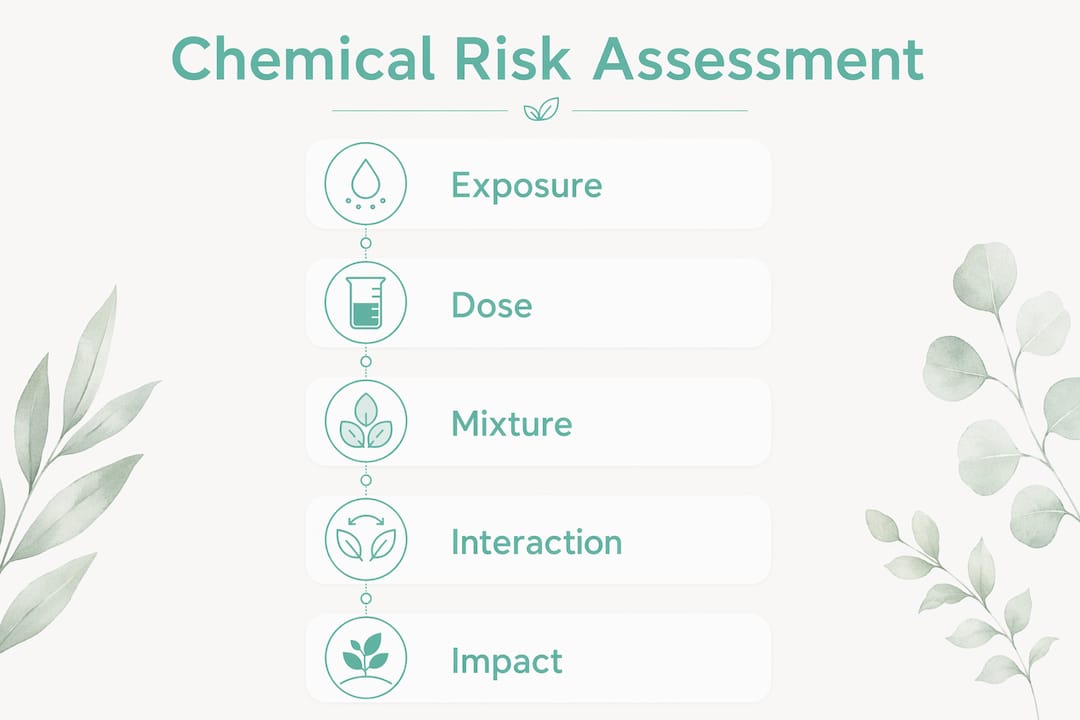
EFSA, the U.S. EPA, and FAO/WHO all use tiered approaches and dose-addition models to evaluate chemical mixtures in food. Dose addition is the default method when chemicals in a mixture share overlapping toxicological effects. Under this model, the combined effect of two chemicals acting on the same biological target is treated as additive, even if each individual dose falls below a concern threshold.
The table below summarizes how the major frameworks approach mixture assessment:
| Agency | Method | Key Tool |
|---|---|---|
| U.S. EPA | Cumulative Assessment Groups (CAGs) | Dose-addition for similar-acting chemicals |
| EFSA | Tiered approach with hazard grouping | Effect-based clustering and biomonitoring |
| FAO/WHO | Joint JECFA evaluations | Total diet studies and exposure modeling |
Human biomonitoring and total diet studies complement these frameworks by measuring actual internal doses rather than relying solely on food contamination data. This means regulators can compare what is theoretically in food with what actually shows up in blood, urine, or tissue samples. The gap between those two numbers is often smaller than feared, but it is not always zero.
“Chemical mixture assessments use grouping logic such as mechanistic or effect-based clusters and dose additivity models, which reflect operational regulatory methods to address real-world complex exposures.” — Risk Assessment of Chemical Mixtures in Foods, MDPI Foods, 2025
The takeaway for consumers is that single-ingredient fear narratives, such as avoiding one preservative while ignoring cumulative exposure from five others, miss the bigger picture. Reviewing how you mix supplements with dog food is one practical way to manage cumulative load in a pet’s diet.
How can you identify safer alternatives without making things worse?
Switching from one chemical to another without proper evaluation can increase rather than decrease risk. The IC2 Alternatives Assessment Guide v1.1 from the Interstate Chemicals Clearinghouse addresses this directly. It warns against “regrettable substitutions,” where a chemical is replaced by one with a similar or worse exposure profile simply because the replacement carries a more natural-sounding name.
The IC2 framework evaluates alternatives across three dimensions:
| Evaluation Dimension | What It Measures | Why It Matters |
|---|---|---|
| Hazard | Toxicity, persistence, bioaccumulation | Identifies intrinsic risks of the substitute |
| Exposure | Dose, frequency, route of contact | Determines real-world risk level |
| Function | Performance equivalence | Confirms the substitute actually works |
The IC2 guide stresses that a replacement chemical must provide functional equivalence and comparable or lower exposure, not just a cleaner-sounding label. This applies directly to pet food and wellness product formulation. A manufacturer replacing a synthetic antioxidant with a plant-based extract needs to verify that the extract delivers the same preservation function at a dose that does not introduce new concerns.
For consumers, the practical steps are straightforward. Request a full ingredient disclosure from manufacturers, including the source and function of each additive. Cross-reference ingredients against the FDA’s food additive database or the EPA’s Safer Chemical Ingredients List. For pet products, resources like the pet wellness nutrition guide at Mindfulbotany provide curated guidance on formulations that prioritize transparency.
A pet nutrition assessment from a qualified veterinary nutritionist can also quantify your pet’s total dietary chemical load across all food and supplement sources, which is the most direct way to manage cumulative exposure.
Pro Tip: When evaluating a “natural” product, ask the manufacturer which specific compounds replace the synthetic ones and at what concentration. If they cannot answer, that is a transparency gap worth noting.
Key takeaways
Chemical safety in food, wellness, and pet products depends on identity, dose, and exposure pathway, not on whether a substance is labeled natural or synthetic.
| Point | Details |
|---|---|
| Regulatory frameworks are pathway-specific | FDA covers food exposure; EPA/TSCA covers industrial and consumer product exposure separately. |
| Natural does not equal safe | Safety depends on chemical identity, dose, and frequency of exposure, not origin. |
| Cumulative exposure matters | Dose-addition models show that multiple low-dose exposures can combine to exceed safe thresholds. |
| Alternatives need full evaluation | The IC2 framework requires functional equivalence and comparable exposure, not just a natural label. |
| Reassessment is ongoing | FDA’s 2026 post-market program means previously approved additives like BHT and ADA are under active review. |
What I’ve learned from years of reading ingredient labels
The most common mistake I see is treating “chemical-free” as a meaningful claim. Every substance is a chemical compound. Water is a chemical. Turmeric contains curcumin, a chemical. The question is never whether a product contains chemicals. The question is which ones, at what dose, and through what exposure route.
What has changed my thinking most is the cumulative exposure research. You can optimize every single product you buy and still carry a meaningful chemical load if you are not accounting for what accumulates across food, supplements, and personal care products simultaneously. That is where the EFSA and EPA mixture frameworks become genuinely useful, not as regulatory abstractions, but as a mental model for how to think about your total daily exposure.
For pets, the stakes feel higher because dogs and cats have smaller body weights, faster metabolisms, and less dietary variety than humans. A preservative that clears quickly in a 150-pound adult may behave differently in a 12-pound cat eating the same formulation daily for years. The clean label dog food guide at Mindfulbotany covers this well.
My recommendation: use public regulatory databases as your primary research tool, not marketing copy. The FDA’s post-market assessment program, the EPA’s ChemView, and the IC2 Alternatives Assessment Guide are all publicly accessible and far more reliable than any “clean” or “natural” claim on a product label.
— Ashley
Natural and synthetic-free options at Mindfulbotany
Mindfulbotany carries products formulated with ingredient transparency as a baseline requirement, not a marketing add-on.

The Couples’ Wellness Pack Hydrating Multivitamin provides daily nutritional support for both partners, formulated without unnecessary synthetic fillers. For pets, the Soft Chew Dog Supplements deliver targeted nutritional support using natural ingredients, with no artificial preservatives or synthetic dyes. Both products reflect the same principle this article covers: knowing exactly what is in a formula and why it is there. Browse the full Mindfulbotany market at mindfulbotany.market for additional natural wellness and pet care options.
FAQ
What is the difference between a food additive and a contaminant?
A food additive is intentionally added to food for a specific function, such as preservation or color, and is regulated by the FDA before use. A contaminant enters food unintentionally through environmental exposure, processing, or packaging and is managed through post-market monitoring programs.
Does “GRAS” mean a chemical is completely safe?
GRAS (Generally Recognized as Safe) means a substance has been determined safe under its intended conditions of use based on available scientific evidence. It does not mean the substance is safe at any dose or in combination with other chemicals, and GRAS status can be reassessed as new data emerges.
How do I know if a pet food additive is under regulatory review?
The FDA publishes its post-market assessment priority list and reassessment notices publicly. Checking the FDA’s food additive database or following updates from the Food Packaging Forum provides current information on additives like BHT that are under active review.
What is a regrettable substitution in chemical safety?
A regrettable substitution occurs when a chemical is replaced by an alternative that turns out to carry similar or greater risk. The IC2 Alternatives Assessment Guide defines this as a failure to evaluate both exposure and function before making a switch, resulting in no net safety gain.
Are organic chemicals in food always safer than synthetic ones?
Organic chemicals, meaning carbon-based compounds, occur in both natural and synthetic forms and carry no inherent safety advantage based on that classification alone. Safety is determined by the specific compound’s toxicity profile, the dose consumed, and the frequency of exposure.
0 comments