


TL;DR:
- Limited ingredient diets are primarily diagnostic tools, containing usually one protein and carbohydrate source to identify food allergies. They are less effective against environmental allergens, fleas, or infections, which require targeted treatments beyond diet changes. Proper use involves vet guidance, strict adherence, and understanding their limitations to ensure accurate diagnosis and effective long-term health management.
Many dog owners switch to limited ingredient food hoping to clear up chronic itching, hot spots, or digestive problems overnight. It sounds logical: fewer ingredients means fewer triggers. But most chronic itch and GI issues are not caused by food at all, and treating every symptom as a food allergy can delay real answers while costing you money and time. This guide breaks down what limited ingredient diets (LIDs) actually are, when they genuinely help, and how to use them the right way so your dog gets real relief instead of a revolving door of food swaps.
Table of Contents
- What does ‘limited ingredient’ actually mean?
- How limited ingredient diets help (and when they don’t)
- OTC, prescription, and hydrolyzed: Key differences that matter
- How to use limited ingredient dog food safely and effectively
- The truth most owners miss about limited ingredient diets
- Support your dog’s wellness journey with the right nutrition and care
- Frequently asked questions
Key Takeaways
| Point | Details |
|---|---|
| True LID definition | A real limited ingredient diet contains one protein and one carb, designed for allergy diagnosis, not as a general-purpose food. |
| LID is not a cure-all | Most dog itching or GI issues are not solely food-related, so LID is not a one-size-fits-all fix. |
| OTC vs prescription | Prescription hydrolyzed diets are typically more reliable than over-the-counter LIDs for diagnosis and safety. |
| Supervised protocols matter | Veterinary-directed elimination and re-challenge are key to confirming food allergy and protecting long-term health. |
| Balanced nutrition is vital | Switch back to a balanced, veterinarian-approved diet after identifying and managing triggers to support your dog’s overall wellbeing. |
What does ‘limited ingredient’ actually mean?
The term “limited ingredient diet” gets used loosely on packaging, in pet stores, and across online forums. Before you pick a bag off the shelf, it helps to understand what the label actually promises and what it does not.
A true LID typically contains one protein source and one carbohydrate source, and it is designed to be used as part of a structured elimination trial under veterinary guidance to identify food-responsive disease. The goal is simple: remove as many variables as possible so you can identify exactly which ingredient is causing a reaction. Think of it like troubleshooting a complicated system by shutting down everything except the bare minimum.
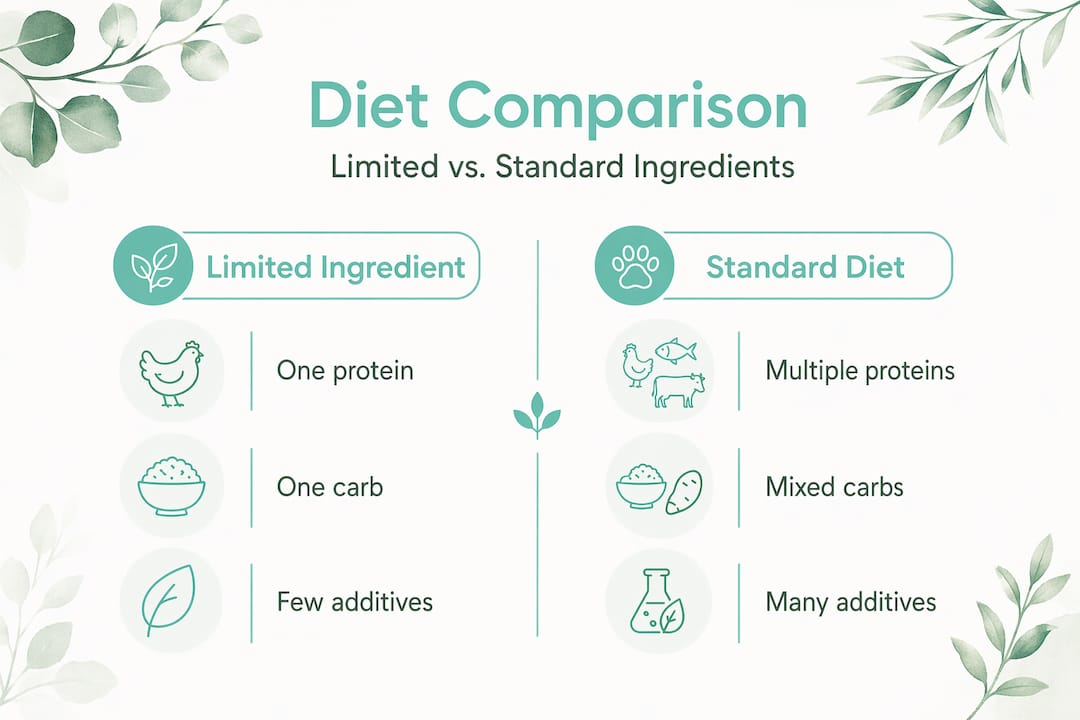
Here is where many owners run into trouble. Not every product labeled “limited ingredient” on the front of the bag actually meets that clinical standard. Some contain flavor additives, multiple protein meals, or supplemental ingredients that introduce more variables than owners realize. Cross-contamination during manufacturing is also a real concern, particularly with over-the-counter (OTC) products made on shared production lines.
Key purposes of a true LID:
- Diagnosing food-responsive dermatitis (skin inflammation from food)
- Identifying food-responsive enteropathy (digestive disease triggered by specific proteins)
- Reducing the number of suspected allergens during a clinical elimination trial
- Serving as a temporary management tool while a vet rules out other conditions
It is also worth understanding what a LID is not. It is not a nutritionally superior food for all dogs. It is not a permanent fix. And it is not a substitute for allergen-free dog food formulated for confirmed long-term sensitivities.
| Feature | True LID | OTC “limited ingredient” |
|---|---|---|
| Protein sources | One (single, novel) | Often one, sometimes more |
| Carbohydrate sources | One | Usually one to two |
| Manufacturing controls | Varies widely | Often shared production lines |
| Vet guidance required | Recommended | Rarely stated |
| Best use case | Elimination trial | General sensitivity management |
“True limited ingredient diets are designed as diagnostic tools first, not lifestyle foods. When used without veterinary guidance, they often produce incomplete or misleading results.” — Puppy Longevity Nutrition Review
Understanding this distinction can save you from cycling through a dozen “limited ingredient” bags without ever getting a real answer about what is affecting your dog.
How limited ingredient diets help (and when they don’t)
Once you know what a limited ingredient diet really is, it is important to understand when it actually helps and when it will not solve the problem.
LIDs are most effective as a diagnostic tool. When a dog has a confirmed or strongly suspected food allergy, placing the dog on a true LID with a novel protein (one the dog has never eaten before) and a single carbohydrate reduces immune exposure enough to determine whether food is actually the trigger. If symptoms resolve after 8 to 12 weeks on the elimination diet, the vet can then reintroduce previous proteins one at a time to identify the culprit.
But here is the part most owners miss: LIDs may not help dogs whose symptoms are driven by environmental allergens, fleas, or infections. And statistically, that covers a large portion of chronically itchy or upset-stomach dogs.
The most common non-food causes of allergy-like symptoms in dogs:
- Environmental allergens (pollen, dust mites, mold spores)
- Flea allergy dermatitis (the most common allergic skin disease in dogs)
- Contact dermatitis (reactions to surfaces, fabrics, cleaning products)
- Bacterial or yeast skin infections that look like allergy flares
- Atopic dermatitis (inherited environmental sensitivity)
Switching food will not address any of the above. A dog with flea allergy dermatitis will keep scratching whether you feed them a grain-free LID or a standard chicken and rice formula. A dog with seasonal atopy will still flare in spring regardless of what protein is in the bowl.
Pro Tip: Before committing to a full elimination diet, ask your vet to rule out flea infestation, environmental triggers, and skin infections. This step alone can save months of unnecessary diet changes.
Approaching a dog’s symptoms with personalized pet diets and a thorough symptom history is far more effective than guessing at food triggers. And when you do start shopping for options, a solid dog food shopping checklist helps you evaluate products objectively rather than based on marketing language alone.
| Trigger type | Will LID help? | What actually helps |
|---|---|---|
| True food allergy | Yes, if used correctly | Elimination trial + vet guidance |
| Flea allergy dermatitis | No | Flea prevention + treatment |
| Environmental atopy | No | Antihistamines, immunotherapy, steroids |
| Yeast or bacterial infection | No | Targeted antibiotics or antifungals |
| Contact dermatitis | No | Identifying and removing the irritant |
OTC, prescription, and hydrolyzed: Key differences that matter
Understanding when and why limited ingredient diets work also means knowing how they differ from other specialty foods on the market. There are three main categories dog owners encounter: over-the-counter LIDs, prescription LIDs, and hydrolyzed protein diets. Each has a different level of reliability and a different appropriate use.
Hydrolyzed protein diets use a process where proteins are broken into pieces too small for the immune system to recognize as an allergen. This makes them particularly useful when a dog has reacted to many common proteins and you need a truly hypoallergenic base for testing. Prescription hydrolyzed protein diets are generally considered more reliable than OTC limited ingredient products for elimination trials because the hydrolysis process reduces the likelihood of triggering immune reactions and these products are often produced under stricter quality controls.

Over-the-counter LIDs vary significantly in quality. Some are genuinely clean products with one protein and minimal additives. Others carry cross-contamination risks from shared manufacturing equipment, which can introduce trace proteins that sabotage an elimination trial without you ever knowing it. This is one reason vets often caution against using OTC products for clinical food trials, especially in dogs with severe or complex presentations.
Prescription diets from veterinary brands undergo more rigorous testing for ingredient purity and are less likely to contain unlisted proteins. They are more expensive, but for a diagnostic elimination trial, that reliability matters.
What to look for when evaluating any LID:
- Single, novel protein source (rabbit, duck, venison, or a protein your dog has never eaten)
- Single carbohydrate source (sweet potato, pea, or tapioca)
- No “natural flavors” listed (often derived from unspecified animal sources)
- Manufactured on a dedicated line, not shared with other formulas
- AAFCO-compliant for complete and balanced nutrition
Pro Tip: Ask your vet or call the manufacturer directly to find out whether a product is made on a shared production line. This information is not always on the label but it significantly affects the reliability of your elimination trial.
It is also worth learning about risks of raw and OTC LID foods before deciding on format. Raw LID diets carry their own set of handling and contamination concerns that can complicate an already sensitive dog’s situation.
How to use limited ingredient dog food safely and effectively
Knowing the differences between product types, let’s look at the correct way to use limited ingredient foods so you do not inadvertently harm your dog’s health or delay a proper diagnosis.
A successful elimination trial requires discipline. Any exposure to outside proteins, even a single treat or bite of table food, can contaminate the trial and make the results unreliable. This is the part many owners underestimate. It only takes one chicken-flavored biscuit to invalidate weeks of strict feeding.
Step-by-step guide to running a proper elimination trial:
- Get a vet diagnosis first. Confirm there is a reasonable suspicion of food allergy and rule out parasites, infections, and environmental triggers.
- Select a truly novel protein and carbohydrate. Choose proteins your dog has never eaten. If your dog has eaten chicken, beef, and fish, consider rabbit, duck, or venison.
- Transition gradually over 7 to 10 days. Mix the new food with the old to reduce gastrointestinal upset during the switch.
- Commit to the full 8 to 12-week trial. Symptoms can take weeks to resolve even after the allergen is removed. Stopping early produces inconclusive results.
- Eliminate all outside treats, table scraps, and flavored medications. Switch to unflavored or single-ingredient treats only, and ask your vet about pill alternatives if your dog takes flavored medications.
- Track symptoms weekly. Note changes in itching, coat quality, stool consistency, and energy.
- Reintroduce proteins one at a time. After symptoms improve, reintroduce one protein every two weeks. A reaction confirms that protein as a trigger.
- Return to a balanced long-term diet. LIDs should not replace a balanced, veterinarian-appropriate diet once the trigger is identified and managed.
Pro Tip: Keep a dedicated food journal for your dog throughout the trial. Record what was eaten each day, any outside exposures, and symptom ratings on a simple 1 to 5 scale. This documentation is invaluable when you return to your vet for follow-up.
Returning to a nutritionally complete diet after a successful trial is important for long-term health. LIDs are tools, not permanent diets. Explore a natural dog nutrition guide to understand what a well-rounded long-term diet looks like once triggers are identified.
The truth most owners miss about limited ingredient diets
After covering the science and the steps, it is worth reflecting on the broader picture. There is something that most owners and even some professionals overlook when it comes to LIDs.
We live in an era where pet food marketing has become enormously sophisticated. Terms like “limited ingredient,” “grain-free,” “ancestral diet,” and “clean label” have taken on near-medicinal authority in the minds of many dog owners. The result is a widespread belief that changing food is the most powerful intervention available for a dog’s chronic health issues. It is not.
The limited ingredient concept is primarily a diagnostic and management tool. Its purpose is to reduce the number of suspected allergenic ingredients so a structured elimination-and-rechallenge protocol can be run properly. Improvement during the elimination phase does not even confirm a food allergy by itself. That confirmation only comes from the reintroduction phase, when symptoms return after a specific protein is reintroduced. Without that step, you have a suggestion, not a diagnosis.
What makes this especially important is the opportunity cost. Every month spent assuming food is the problem, cycling through LID after LID, is a month a dog with environmental atopy, flea allergy, or a secondary yeast infection is going without targeted treatment. Atopic dermatitis, for example, is typically managed with immunotherapy, targeted medications, or allergy testing for environmental triggers. None of that involves changing the food bowl.
The most effective approach to chronic skin or GI issues in dogs involves a veterinarian-directed, multi-pronged strategy. That means addressing parasites, testing for infections, considering environmental exposures, and evaluating diet as one variable among many, not the first and only suspect. A good pet wellness nutrition guide can help owners understand where diet fits into the overall health picture without overweighting its role.
LIDs have real value when used correctly. The problem is not the tool. It is the assumption that the tool is a solution to every problem.
Support your dog’s wellness journey with the right nutrition and care
Managing food sensitivities and long-term wellness requires more than a diet swap. It calls for a balanced, evidence-informed strategy that includes high-quality nutrition and targeted supplementation.
Mindful Botany Market carries carefully selected products suited to dogs with dietary sensitivities and specific nutritional needs. For dogs who benefit from simple, clean nutrition, the single-ingredient dog food option from Against the Grain provides 100% beef with nothing added, making it a reliable protein source during or after a structured elimination trial. To support skin, joint, and digestive health alongside dietary management, soft chew dog supplements offer targeted nutritional support without introducing unnecessary ingredients. Both options reflect a practical, low-variable approach to everyday dog wellness.
Frequently asked questions
Can limited ingredient dog food cure allergies?
No. LID can help identify and manage some food-triggered allergies, but most dog allergies are driven by environmental factors, parasites, or infections rather than food ingredients.
How long should my dog be on a limited ingredient diet?
Veterinarians recommend a strict exclusion of 8 to 12 weeks for an elimination trial, followed by controlled reintroduction of proteins to confirm any food triggers.
Is over-the-counter limited ingredient dog food as good as prescription?
OTC LIDs can help some dogs, but prescription and hydrolyzed diets are generally more reliable for structured allergy trials due to stricter production controls and reduced cross-contamination risk.
Is it safe to keep my dog on a LID long-term?
Most dogs should not stay on a LID indefinitely. LIDs should not replace a complete, balanced diet once the food trigger has been identified and managed with veterinary guidance.
What’s the difference between a limited ingredient and hypoallergenic dog food?
LIDs reduce the total number of ingredients to simplify allergy testing, while hypoallergenic foods use hydrolyzed or novel proteins specifically designed to minimize immune reactions from the start.
Recommended
- Clean label dog food: Benefits, risks, and how to choose – Mindful Botany Market
- Healthy dog food: how to choose the best for your pet – Mindful Botany Market
- Freeze-dried dog food: Benefits, process, and tips – Mindful Botany Market
- Natural pet food benefits for your dog’s health – Mindful Botany Market
0 comments